

How to Build a Sustainable Productivity System That Lasts is a practical guide for turning a broad intention into observable work. It focuses on decisions, examples, tradeoffs, and feedback rather than promising a perfect routine. Use the ideas as a starting point and adapt them to your context, energy, responsibilities, and assessment or workplace requirements.
Define sustainable productivity
A sustainable productivity system helps you do important work repeatedly without spending your health, relationships, or attention as fuel. It is not a maximal schedule, a collection of apps, or a promise to feel motivated every morning. It is a small set of decisions that makes commitments visible, limits work in progress, and leaves room to recover and change direction.
Start with values and constraints. What outcomes matter this season, what responsibilities are non-negotiable, and what capacity is genuinely available? A system built for an imaginary version of your life will generate shame when reality arrives. Write a short list of current commitments and decide what will not receive active attention for now.
Create a trusted capture system
Use one trusted capture point for tasks, ideas, and requests. Process it regularly into a next action, calendar commitment, waiting-for list, reference note, or deliberate deletion. Capture is not completion. The system earns trust when every item has a review path and you can stop holding reminders in your head.
Connect longer goals to weekly actions. A goal such as “improve writing” becomes a weekly practice block, a reading target, feedback, and a review. Limit the number of active projects. The PomoDomate planner can show when work fits; a timer can help you begin without turning every minute into a performance metric.
- Make it visible: write the next action and the evidence of completion.
- Keep it small: choose a block that can survive an ordinary day.
- Review it: use feedback to change the next attempt.
Connect goals to weekly actions
Plan capacity, not aspiration. Protect sleep, meals, movement, relationships, and transition time before assigning deep work. Add buffers for interruptions and estimates that are wrong. If your list exceeds capacity, the system should force a choice: reduce scope, extend a deadline, delegate, or decline.
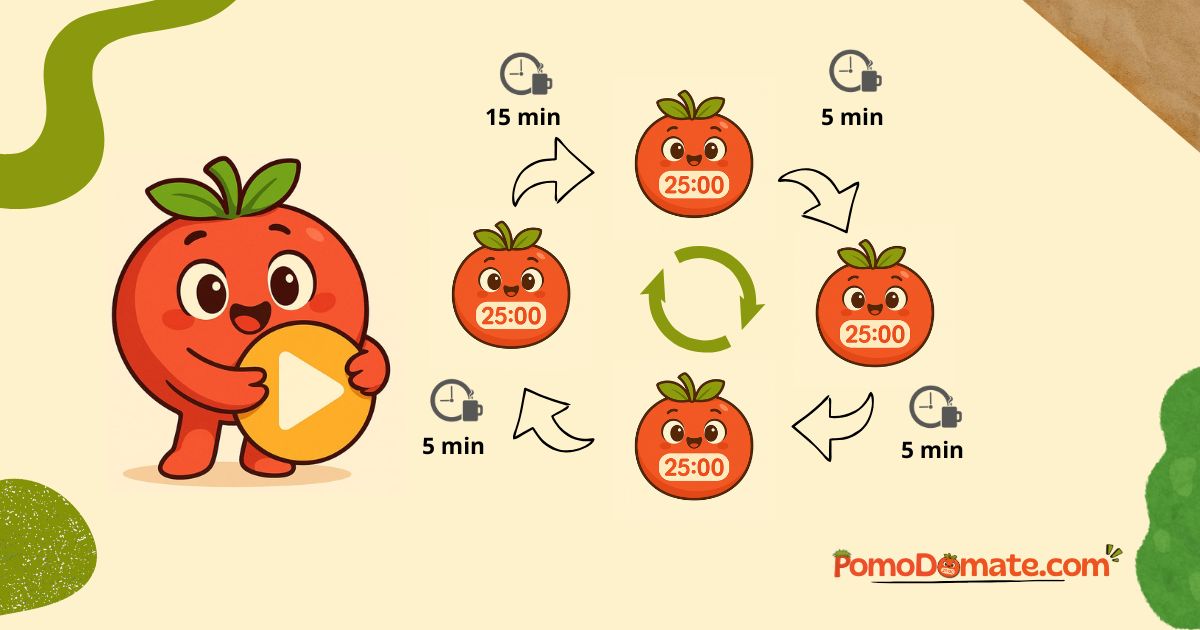
Focus is easier when the next action is concrete and the environment has fewer competing cues. Choose an interval that fits the task, capture distractions, and leave a breadcrumb before stopping. Use longer uninterrupted blocks for complex work and shorter sessions for starting, review, or variable energy. Flexibility is a feature when it preserves the outcome.
Plan capacity and focus
Run a weekly review with three parts: clear, decide, and learn. Clear stale captures and check commitments. Decide the next actions and priorities. Learn from the gap between plan and reality. Do not ask only whether you were disciplined; ask whether the system made the important work visible and the workload feasible.
Design a bad-week version. It might contain one essential task per day, a ten-minute reset, a minimum study or work block, and permission to pause optional projects. When illness, grief, deadlines, or caregiving disrupt the plan, reduce the system rather than abandoning it. Restart with the next small action, not a punishment backlog.
- Make it visible: write the next action and the evidence of completion.
- Keep it small: choose a block that can survive an ordinary day.
- Review it: use feedback to change the next attempt.
Review without self-judgement
Measure outcomes that matter: finished deliverables, learning demonstrated, decisions made, recovery protected, and commitments kept. Hours, streaks, and app points can provide clues but are not the goal. Compare metrics over a suitable period and avoid using them to judge people whose health or responsibilities differ from yours.
Every system has tradeoffs. More structure can reduce choice but feel restrictive; more flexibility can support autonomy but hide avoidance. Digital tools offer reminders and search but add notifications and dependency. Paper offers simplicity but less automation. Test one change for two weeks, keep what improves results, and remove administration that does not.
Design for bad weeks
Sustainability is not a personal failure issue when the workload is structurally excessive. Talk with a manager, teacher, client, or support service about scope and expectations. Seek professional help for persistent burnout, anxiety, depression, sleep problems, or attention difficulties. Productivity tools can support care; they cannot replace it.
- Make it visible: write the next action and the evidence of completion.
- Keep it small: choose a block that can survive an ordinary day.
- Review it: use feedback to change the next attempt.
Measure what matters
A worked example you can adapt
Imagine a learner who has one clear outcome related to how to build a sustainable productivity system that lasts. They begin by checking the real constraint, gather only the materials needed, and write the smallest useful next action. Instead of measuring success by time seated, they define evidence: an explanation, solved set, draft, decision, or reviewed record. This makes the method inspectable. If the first attempt reveals a gap, the learner records the gap and schedules a targeted second attempt rather than restarting the entire plan.
The learner then runs a short experiment across several ordinary days. They vary one factor at a time: the length of the focus block, the order of tasks, the amount of preparation, or the time of day. At the end of each block they record what was produced, what caused friction, and what should happen next. This simple log prevents a single unusually good or bad day from becoming a sweeping conclusion about their ability.
At the end of the week, they keep the parts that improved quality or reduced unnecessary effort. They remove attractive administration that did not change the result. The revised routine is deliberately modest: a dependable capture point, a visible priority, a realistic block, and a short review. That is enough structure to support progress while leaving room for work, relationships, health, and unexpected events.
Tradeoffs, risks, and decision rules
Every productivity or learning choice has a cost. More detail can improve clarity but consume attention; more flexibility can respect changing energy but make avoidance easier. A timer can protect a boundary but interrupt work that benefits from continuity. A checklist can reduce memory load but become another task to maintain. Choose the simplest option that addresses the current failure mode, and revisit the choice when conditions change.
Use a decision rule instead of relying on mood. For example: if a task takes more than one session, define an intermediate deliverable; if you miss two planned blocks, reduce scope before adding hours; if a note is never retrieved, convert it into a question or archive it; if a meeting has no decision, replace it with an update. Rules make adaptation faster and less personal.
Seven-day implementation checklist
- Write the outcome and the constraint.
- Prepare the smallest useful workspace.
- Complete one bounded focus block.
- Record evidence and one obstacle.
- Ask for feedback or compare with a reliable standard.
- Repeat after a delay instead of cramming.
- Review the week and change one variable.
Troubleshooting a difficult week
When the routine breaks, diagnose before redesigning. A missed session may reflect an underestimated task, a missing prerequisite, an interruption, low energy, or a deadline that changed. Write down what actually happened and choose the narrowest repair. You might split a deliverable, move it to a better energy window, request information, or remove a nonessential step. Avoid responding to one bad day by adding an elaborate system that creates more maintenance.
If progress is slow, use an external standard. Compare an answer with a worked solution, a draft with the rubric, a file with the naming rule, or a meeting with its intended decision. External feedback is more informative than a feeling of effort. Ask a teacher, colleague, partner, librarian, or accessibility professional for a specific observation when you cannot identify the gap yourself.
Finally, protect the conditions that make repetition possible. Leave a clear stopping point, keep essential materials accessible, and make the next start easy. Rest, food, movement, sleep, and supportive relationships are not distractions from performance; they are part of the capacity that performance uses. A sustainable method is allowed to be ordinary, adjustable, and incomplete.
Keep a short record of the experiment: the date, the context, the chosen method, the evidence produced, and the next adjustment. Over several weeks this record reveals patterns that memory misses. You may discover that a particular task needs a different setting, that preparation saves more time than it costs, or that a recurring deadline requires earlier communication. Use those observations to improve the system, not to label yourself.
Frequently asked questions
How long should I work or study at once?
Start with a short, clearly bounded interval and judge it by useful output, recall, or decisions. A 25-minute Pomodoro is a practical starting point, but some tasks need a longer uninterrupted block and some people need shorter intervals. Adjust the boundary without treating it as a test of character.
What if my plan stops working?
Keep the goal, inspect the constraint, and change one variable: scope, timing, method, support, or environment. Move unfinished work deliberately instead of copying an impossible list forward. If the workload remains larger than your capacity, renegotiate it.
Is this system guaranteed to improve performance?
No. Planning is a support, not a guarantee. Evidence, practice, feedback, sleep, accessibility, and the quality of the underlying task all matter. Test the method in your context and keep records that help you make better decisions.
Sources and further reading
For evidence-informed learning and work practices, consult the Australian Education Research Organisation guide to learning and memory, the Columbia University learning science resources, and the World Health Organization information on mental health. Compare the ideas with PomoDomate’s weekly review guide and effective study techniques.
Design for bad weeks, not ideal weeks
A sustainable system includes a minimum version for travel, illness, deadlines, family responsibilities, and low-energy days. Decide in advance what you will preserve: perhaps one daily priority, a short capture habit, and a weekly review. When capacity returns, rebuild gradually instead of trying to compensate for every missed task.
Use friction as diagnostic information. If a routine repeatedly fails at the same point, change the design: reduce the number of tools, shorten the planning ritual, clarify the next action, or move the work to a more suitable time. Discipline can help you use a system, but it cannot make a badly designed system fit your life.
Review outcomes, not activity signals
Counts can be useful, but they are not the goal. Review completed outcomes, quality of work, learning retained, commitments kept, and recovery protected. A week with fewer sessions may be successful if it contained the right work and avoided preventable overload. Keep only the measurements that help you make a better next decision.