


How to Plan a Group Project: Roles, Milestones, and Accountability is a practical guide for turning a broad intention into observable work. It focuses on decisions, examples, tradeoffs, and feedback rather than promising a perfect routine. Use the ideas as a starting point and adapt them to your context, energy, responsibilities, and assessment or workplace requirements.
Turn the brief into a shared definition
A group project fails less often because everyone is enthusiastic than because the work is made visible. The team needs a shared definition of the deliverable, a map of dependencies, a way to make decisions, and checkpoints before the deadline. Planning should reduce ambiguity without pretending that people have identical schedules, skills, or access to technology.
Begin with the brief. Rewrite the assignment in plain language, list required components, identify the audience and marking criteria, and note constraints such as file format, length, sources, or presentation time. Ask each member to restate the deliverable. Different interpretations discovered early are cheap to fix; discovered on submission day they are expensive.
Choose roles without silos
Break the project into outputs rather than vague roles. “Research” is not a complete task; “find and annotate three peer-reviewed sources for the methods section by Tuesday” is. Give each output an owner and a reviewer. Ownership means coordinating completion, not doing every part alone. A reviewer catches blind spots and prevents a single person becoming the only quality gate.
Roles can be functional—facilitator, researcher, analyst, writer, designer, presenter—or rotating. Match responsibilities to learning goals and availability, but avoid permanent status hierarchies. Record decisions so a quiet member’s contribution is not invisible. If the project is assessed individually, check the institution’s rules before sharing work or dividing assessed components.
- Make it visible: write the next action and the evidence of completion.
- Keep it small: choose a block that can survive an ordinary day.
- Review it: use feedback to change the next attempt.
Build milestones and dependencies
Create a milestone map from the final deadline backwards. Include brief interpretation, research, outline, first draft, integration, feedback, rehearsal, and submission. Add dependencies: the designer needs approved content; the presenter needs a stable narrative; the editor needs all sections. Place an internal deadline before the official one to absorb illness, technical failure, or a late source.
Use a board or table with columns for ready, doing, review, and done. Limit work in progress so the team does not start ten tasks and finish none. A shared document can hold the brief and decisions, while a PomoDomate planner can protect each person’s focus blocks. The tools matter less than a single trusted status view.
Agree on communication
Agree on communication norms in writing: where updates live, how quickly urgent questions receive a response, what counts as urgent, and when meetings are possible. Use asynchronous updates for status and reserve meetings for decisions, teaching, or conflict. A concise update names what changed, what is blocked, and what is needed from someone else.
When disagreement appears, return to the criteria and evidence. State the decision, options, tradeoffs, and owner; then record it. If consensus is not necessary, use a named decision-maker after hearing the relevant views. Address missed commitments privately and early, with a specific new plan. Escalate through the instructor or project supervisor when the team cannot resolve a material risk.
- Make it visible: write the next action and the evidence of completion.
- Keep it small: choose a block that can survive an ordinary day.
- Review it: use feedback to change the next attempt.
Make decisions and resolve conflict
Run a quality checkpoint before polishing slides or formatting. Test the work against the rubric, check that claims have evidence, compare sections for consistent definitions, and read the complete deliverable as an audience member. A 25-minute focus block is often enough for one review pass; schedule several rather than expecting one heroic night.
A group project needs a contribution record: decisions, drafts, feedback, and completed outputs. Keep it factual, not punitive. If a member becomes unavailable, use the dependency map to identify the smallest reassignment and tell the instructor early. Protect accessibility, cultural differences, time zones, and caring responsibilities when setting meetings and response expectations.
Review quality before submission
No plan eliminates unequal participation. Some tasks are inherently less visible, and people may face language, disability, work, or connectivity barriers. Build multiple ways to contribute and measure outputs rather than personality. Seek formal support for harassment, discrimination, or serious non-participation; peer pressure is not a substitute for institutional process.
- Make it visible: write the next action and the evidence of completion.
- Keep it small: choose a block that can survive an ordinary day.
- Review it: use feedback to change the next attempt.
FAQs and limitations
A worked example you can adapt
Imagine a learner who has one clear outcome related to how to plan a group project: roles, milestones, and accountability. They begin by checking the real constraint, gather only the materials needed, and write the smallest useful next action. Instead of measuring success by time seated, they define evidence: an explanation, solved set, draft, decision, or reviewed record. This makes the method inspectable. If the first attempt reveals a gap, the learner records the gap and schedules a targeted second attempt rather than restarting the entire plan.
The learner then runs a short experiment across several ordinary days. They vary one factor at a time: the length of the focus block, the order of tasks, the amount of preparation, or the time of day. At the end of each block they record what was produced, what caused friction, and what should happen next. This simple log prevents a single unusually good or bad day from becoming a sweeping conclusion about their ability.
At the end of the week, they keep the parts that improved quality or reduced unnecessary effort. They remove attractive administration that did not change the result. The revised routine is deliberately modest: a dependable capture point, a visible priority, a realistic block, and a short review. That is enough structure to support progress while leaving room for work, relationships, health, and unexpected events.
Tradeoffs, risks, and decision rules
Every productivity or learning choice has a cost. More detail can improve clarity but consume attention; more flexibility can respect changing energy but make avoidance easier. A timer can protect a boundary but interrupt work that benefits from continuity. A checklist can reduce memory load but become another task to maintain. Choose the simplest option that addresses the current failure mode, and revisit the choice when conditions change.
Use a decision rule instead of relying on mood. For example: if a task takes more than one session, define an intermediate deliverable; if you miss two planned blocks, reduce scope before adding hours; if a note is never retrieved, convert it into a question or archive it; if a meeting has no decision, replace it with an update. Rules make adaptation faster and less personal.
Seven-day implementation checklist
- Write the outcome and the constraint.
- Prepare the smallest useful workspace.
- Complete one bounded focus block.
- Record evidence and one obstacle.
- Ask for feedback or compare with a reliable standard.
- Repeat after a delay instead of cramming.
- Review the week and change one variable.
Troubleshooting a difficult week
When the routine breaks, diagnose before redesigning. A missed session may reflect an underestimated task, a missing prerequisite, an interruption, low energy, or a deadline that changed. Write down what actually happened and choose the narrowest repair. You might split a deliverable, move it to a better energy window, request information, or remove a nonessential step. Avoid responding to one bad day by adding an elaborate system that creates more maintenance.
If progress is slow, use an external standard. Compare an answer with a worked solution, a draft with the rubric, a file with the naming rule, or a meeting with its intended decision. External feedback is more informative than a feeling of effort. Ask a teacher, colleague, partner, librarian, or accessibility professional for a specific observation when you cannot identify the gap yourself.
Finally, protect the conditions that make repetition possible. Leave a clear stopping point, keep essential materials accessible, and make the next start easy. Rest, food, movement, sleep, and supportive relationships are not distractions from performance; they are part of the capacity that performance uses. A sustainable method is allowed to be ordinary, adjustable, and incomplete.
Keep a short record of the experiment: the date, the context, the chosen method, the evidence produced, and the next adjustment. Over several weeks this record reveals patterns that memory misses. You may discover that a particular task needs a different setting, that preparation saves more time than it costs, or that a recurring deadline requires earlier communication. Use those observations to improve the system, not to label yourself.
Frequently asked questions
How long should I work or study at once?
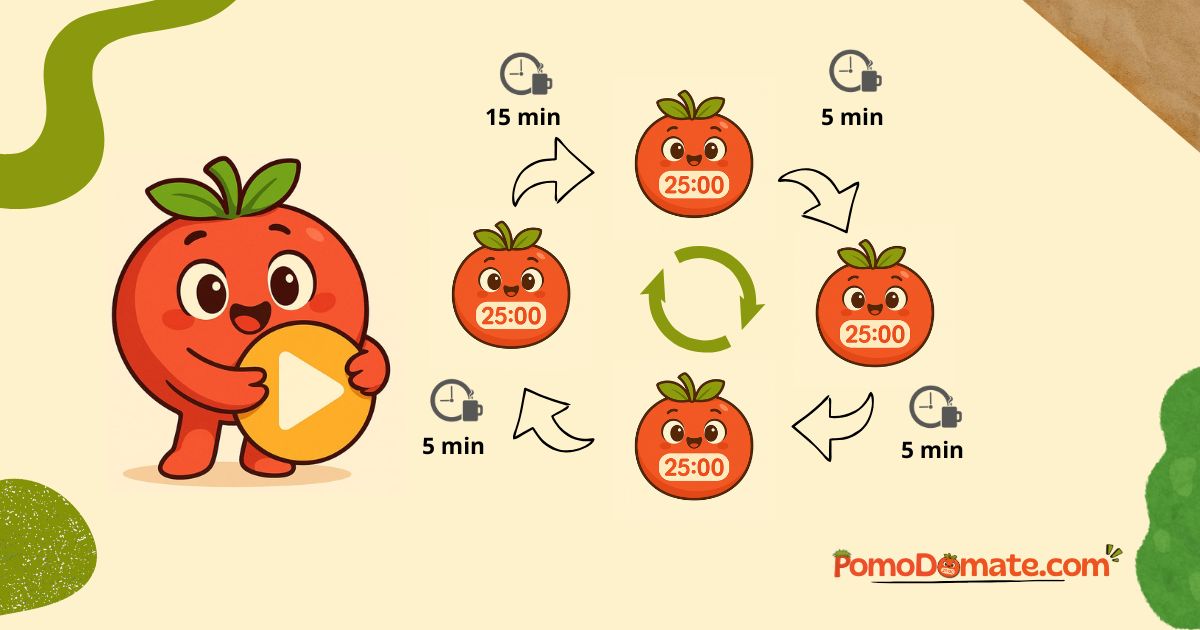
Start with a short, clearly bounded interval and judge it by useful output, recall, or decisions. A 25-minute Pomodoro is a practical starting point, but some tasks need a longer uninterrupted block and some people need shorter intervals. Adjust the boundary without treating it as a test of character.
What if my plan stops working?
Keep the goal, inspect the constraint, and change one variable: scope, timing, method, support, or environment. Move unfinished work deliberately instead of copying an impossible list forward. If the workload remains larger than your capacity, renegotiate it.
Is this system guaranteed to improve performance?
No. Planning is a support, not a guarantee. Evidence, practice, feedback, sleep, accessibility, and the quality of the underlying task all matter. Test the method in your context and keep records that help you make better decisions.
Sources and further reading
For evidence-informed learning and work practices, consult the Australian Education Research Organisation guide to learning and memory, the Columbia University learning science resources, and the World Health Organization information on mental health. Compare the ideas with PomoDomate’s weekly review guide and effective study techniques.
Make dependencies visible
Many group delays happen because one person is waiting for information another person has not delivered. Create a simple dependency list: what must exist before each task can begin, who provides it, and when it is needed. A design cannot be finalized before the requirements are agreed; a presentation cannot be rehearsed before the content is stable.
Review dependencies at each meeting and raise risks early. The purpose is not to monitor people constantly but to make invisible waiting visible while there is still time to change the plan. If a task is blocked, record the decision or question required to unblock it rather than assigning the same task again.
Protect the final integration stage
Leave time to combine the pieces. Individual sections can be correct and still produce a confusing final project when terminology, formatting, evidence, or assumptions differ. Assign one integration pass with a clear checklist, then ask each contributor to verify the part they own. This is different from asking one person to do everyone else's work at the last minute.