


How to Run a Productive Meeting: Agenda, Decisions, and Follow-Through is a practical guide for turning a broad intention into observable work. It focuses on decisions, examples, tradeoffs, and feedback rather than promising a perfect routine. Use the ideas as a starting point and adapt them to your context, energy, responsibilities, and assessment or workplace requirements.
Decide whether a meeting is needed
A productive meeting is not one in which everyone speaks for an equal number of minutes. It is one in which the right people make or improve a decision, solve a problem, or create shared understanding, then leave knowing what happens next. If the purpose is only to broadcast information, an update may be more respectful of everyone’s time.
State the purpose as an outcome: choose a launch date, resolve a design tradeoff, review a risk, or teach a process. Identify the decision owner and the people whose expertise or accountability is necessary. A large audience may be useful for communication, but it is often inefficient for decision-making.
Write an outcome-based agenda
Write an agenda with time, topic, desired outcome, and preparation. Send the relevant document early enough to read. A vague item such as “project update” invites status monologues; “identify the two risks that need an owner” directs attention. Keep a parking lot for related topics that do not serve the meeting purpose.
Open by naming the goal, constraints, and decision process. Invite contributions through a round, silent writing, chat, or targeted questions so fast speakers do not define the whole conversation. Summarise points of agreement and disagreement. Inclusive facilitation is not just politeness; it improves the information available to the decision.
- Make it visible: write the next action and the evidence of completion.
- Keep it small: choose a block that can survive an ordinary day.
- Review it: use feedback to change the next attempt.
Prepare people and materials
Control the clock without cutting off important concerns. Ask whether a point changes the decision, belongs in the parking lot, or needs a separate owner. When discussion loops, restate the options and evidence, then ask the decision owner to choose or schedule the missing information. Record dissent without requiring endless consensus.
A decision record should include the decision, date, owner, rationale, alternatives considered, and review point if the choice is reversible. Action items need one accountable owner and a date; “the team will look into it” is not an action. Share the record promptly in the team’s trusted workspace.
Facilitate participation
End with a verbal read-back: what was decided, who does what, and by when. Use a timer for agenda sections when meetings routinely expand, and protect follow-up work in the planner. The meeting is not complete when the video call closes; it is complete when the work can proceed.
Review meeting health monthly. Track whether the stated outcomes were achieved, how many actions were completed, and which recurring meetings could become asynchronous. Ask participants for one improvement, but interpret feedback alongside observable results. A shorter meeting with better preparation is not automatically better if it pushes hidden work into unpaid or invisible time.
- Make it visible: write the next action and the evidence of completion.
- Keep it small: choose a block that can survive an ordinary day.
- Review it: use feedback to change the next attempt.
Make decisions visible
Remote and hybrid meetings need extra care: share documents accessibly, describe visual content, account for time zones, and offer an asynchronous route for people who cannot attend. Do not equate camera use with engagement. For sensitive conflict, use the appropriate manager, mediator, or institutional process rather than forcing resolution in a crowded call.
Close with owners and dates
- Make it visible: write the next action and the evidence of completion.
- Keep it small: choose a block that can survive an ordinary day.
- Review it: use feedback to change the next attempt.
Measure and improve
A worked example you can adapt
Imagine a learner who has one clear outcome related to how to run a productive meeting: agenda, decisions, and follow-through. They begin by checking the real constraint, gather only the materials needed, and write the smallest useful next action. Instead of measuring success by time seated, they define evidence: an explanation, solved set, draft, decision, or reviewed record. This makes the method inspectable. If the first attempt reveals a gap, the learner records the gap and schedules a targeted second attempt rather than restarting the entire plan.
The learner then runs a short experiment across several ordinary days. They vary one factor at a time: the length of the focus block, the order of tasks, the amount of preparation, or the time of day. At the end of each block they record what was produced, what caused friction, and what should happen next. This simple log prevents a single unusually good or bad day from becoming a sweeping conclusion about their ability.
At the end of the week, they keep the parts that improved quality or reduced unnecessary effort. They remove attractive administration that did not change the result. The revised routine is deliberately modest: a dependable capture point, a visible priority, a realistic block, and a short review. That is enough structure to support progress while leaving room for work, relationships, health, and unexpected events.
Tradeoffs, risks, and decision rules
Every productivity or learning choice has a cost. More detail can improve clarity but consume attention; more flexibility can respect changing energy but make avoidance easier. A timer can protect a boundary but interrupt work that benefits from continuity. A checklist can reduce memory load but become another task to maintain. Choose the simplest option that addresses the current failure mode, and revisit the choice when conditions change.
Use a decision rule instead of relying on mood. For example: if a task takes more than one session, define an intermediate deliverable; if you miss two planned blocks, reduce scope before adding hours; if a note is never retrieved, convert it into a question or archive it; if a meeting has no decision, replace it with an update. Rules make adaptation faster and less personal.
Seven-day implementation checklist
- Write the outcome and the constraint.
- Prepare the smallest useful workspace.
- Complete one bounded focus block.
- Record evidence and one obstacle.
- Ask for feedback or compare with a reliable standard.
- Repeat after a delay instead of cramming.
- Review the week and change one variable.
Troubleshooting a difficult week
When the routine breaks, diagnose before redesigning. A missed session may reflect an underestimated task, a missing prerequisite, an interruption, low energy, or a deadline that changed. Write down what actually happened and choose the narrowest repair. You might split a deliverable, move it to a better energy window, request information, or remove a nonessential step. Avoid responding to one bad day by adding an elaborate system that creates more maintenance.
If progress is slow, use an external standard. Compare an answer with a worked solution, a draft with the rubric, a file with the naming rule, or a meeting with its intended decision. External feedback is more informative than a feeling of effort. Ask a teacher, colleague, partner, librarian, or accessibility professional for a specific observation when you cannot identify the gap yourself.
Finally, protect the conditions that make repetition possible. Leave a clear stopping point, keep essential materials accessible, and make the next start easy. Rest, food, movement, sleep, and supportive relationships are not distractions from performance; they are part of the capacity that performance uses. A sustainable method is allowed to be ordinary, adjustable, and incomplete.
Keep a short record of the experiment: the date, the context, the chosen method, the evidence produced, and the next adjustment. Over several weeks this record reveals patterns that memory misses. You may discover that a particular task needs a different setting, that preparation saves more time than it costs, or that a recurring deadline requires earlier communication. Use those observations to improve the system, not to label yourself.
Frequently asked questions
How long should I work or study at once?
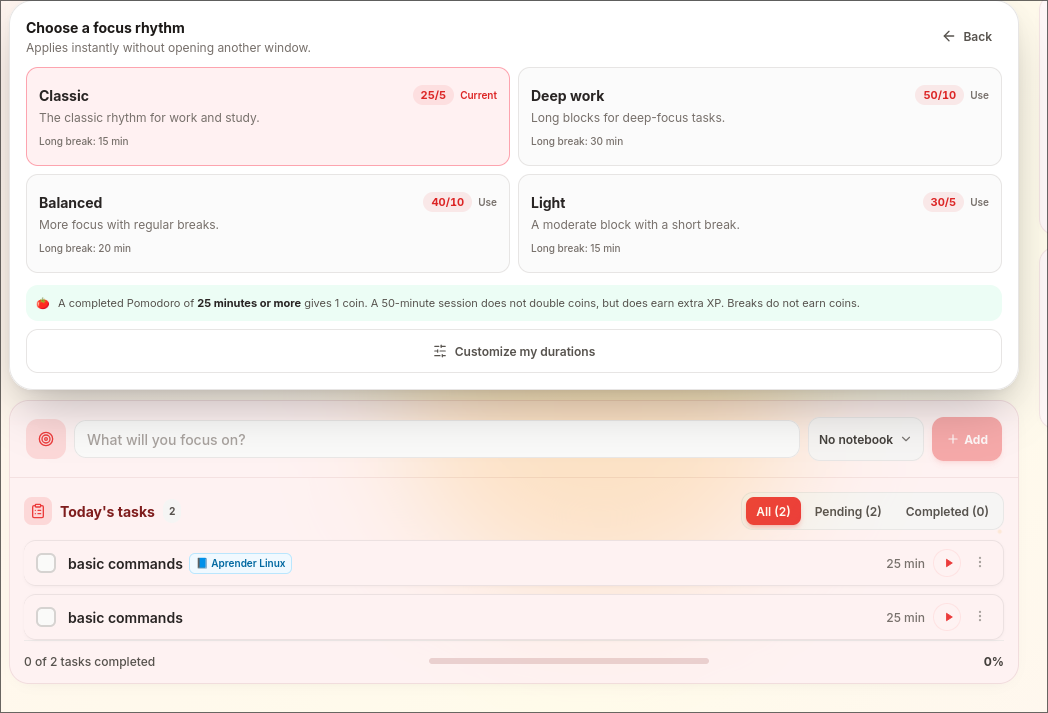
Start with a short, clearly bounded interval and judge it by useful output, recall, or decisions. A 25-minute Pomodoro is a practical starting point, but some tasks need a longer uninterrupted block and some people need shorter intervals. Adjust the boundary without treating it as a test of character.
What if my plan stops working?
Keep the goal, inspect the constraint, and change one variable: scope, timing, method, support, or environment. Move unfinished work deliberately instead of copying an impossible list forward. If the workload remains larger than your capacity, renegotiate it.
Is this system guaranteed to improve performance?
No. Planning is a support, not a guarantee. Evidence, practice, feedback, sleep, accessibility, and the quality of the underlying task all matter. Test the method in your context and keep records that help you make better decisions.
Sources and further reading
For evidence-informed learning and work practices, consult the Australian Education Research Organisation guide to learning and memory, the Columbia University learning science resources, and the World Health Organization information on mental health. Compare the ideas with PomoDomate’s weekly review guide and effective study techniques.
Design the meeting around decisions
For each agenda item, state whether the group needs to decide, generate options, share information, or solve a problem. Information that does not require discussion may belong in a written update. A decision item should include the context, the options, the decision owner, and the time available.
When discussion expands, summarize the current position and name the unresolved question. This prevents the group from repeating earlier points without knowing what is missing. If the decision depends on data that is not available, record the dependency and assign a next action instead of pretending the meeting resolved it.
Make follow-through easy
Close by reading the action list aloud: owner, action, due date, and definition of done. Send the notes while the context is fresh and link them to the relevant project. At the next meeting, review only actions that need attention; a status recital for every task can consume the time needed for actual decisions.
Invite only the people needed for the outcome
Attendance should match the work. Include people who make the decision, provide essential context, or will carry out a significant action. Share background in advance so meeting time is used for judgment and coordination rather than reading a document aloud. People who are not needed can receive the decision and action record afterward.
For recurring meetings, review the invitation every few weeks. Remove agenda items that no longer need live discussion, shorten the default duration when the work allows it, and cancel the meeting when a written update can achieve the same outcome.